Wednesday, April 27, 2011
Nice Confidence Session Before the Nationals
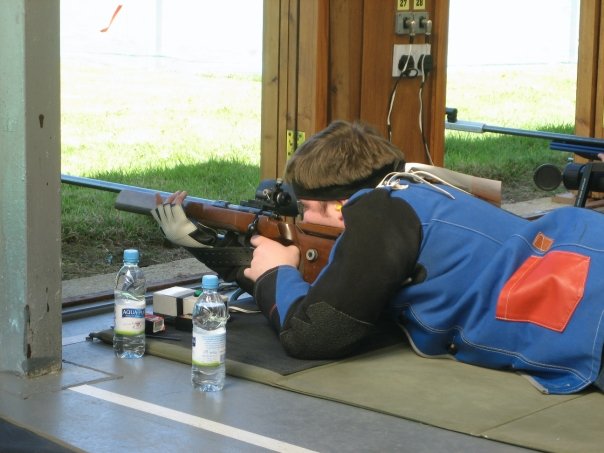
Always good to finish feeling in control before a competition. I've been listening to the Bassham stuff on mental management a good bit and the result is that I'm feeling my shot routine better in terms of a process and accompanying series of images. I've also been experimenting with a sling position on my forward arm, coming around the wrist rather than the back of the hand, and the results are very positive. The changes now are that I feel my head sitting better on top of the rifle, much more vertical sense of support, and my comfort levels are much better, from shot to shot and after finishing. Recovery time for comfort levels is greatly improved. My condition wasn't the best for shooting this evening. A long day hunched over a desk, staring at paper and screens wasn't doing much good for either muscles or eyes (I couldn't hold a sight picture for more than about three seconds) but the process was good, and it was consistent. Trigger control is greatly improved, though consistency still needs to be better. A couple of shots broke unexpectedly today for loose tens, but most were well controlled. It's an element of the process that's still developing. When my eyesight was proving troublesome, I trusted to the inner position and the hold, and shot well. I sighted in and shot two groups of ten, for a 197, and all the bad shots were well known. This is the final group. The 9.9 wasn't something I saw, but with my dodgy eyes, who knows... I'm happy that it felt controlled anyway. There were some looser tens where I might have overheld or was a little rough on the trigger, but it's all coming together.

Wednesday, April 20, 2011
Mental Training and Approach to Training for Next Three Months
I've finally gotten hold of the Lanny Bassham materials on mental training for shooters from a Friend after quite a long time of meaning to get them and never getting around to it. I listened to all of Mental Management for Shooting Sports yesterday, and far from feeling bored and lectured at, it was fascinating. I intend listening to this often to reaffirm my approach, but most importantly, I've taken his points on progressive training and have set myself a timeframe within which to work, over the next three months, on significantly improving the process of my shooting.
He advocates training in three stages: Dry-firing, group-shooting and live shooting, on both an individual session basis and on a larger scale, over a season. What this means is that the process becomes much, much more important than the result, as, ignoring groups, which merely provide a reference for the observer, perhaps only ten to twenty shots will be individually observed and remarked on out of perhaps a hundred processes. I am going to make this a feature of all of my training sessions from now on, and am going to condense a season's worth of progressive training into the next three months, focusing heavily on dry-fire for the next month or so (and moving the rifle home at the weekend to dry-fire against the wall, since it will help me avoid temptation to train in college before the exams), then shifting the emphasis towards group-shooting, and then live fire for the last month or so. I hope to see a significant improvement in my performance by then, and hopefully in time to qualify for the European Championships, the qualifications for which I expect will begin in May or June.
The other element I took from the lecture was the correlation of a mental programme with the physical shot routine. I've since sketched out my shot routine again and noted the stages in the mental programme of visualisation and positive reinforcement against their corresponding points on the shot routine. This is proving extremely interesting for my mental visualisation (What Bassham calls rehearsal) as I can see everything so clearly in my head now, while focusing on the process. As I'm loading the rifle I'm visualising the sight picture, the little hope of the foresight and the settling down on point of aim again, feeling the little thud of recoil. As I'm settling I'm noting the wind flags and the mirage and picturing them exactly as they will be when I break the shot. As I'm checking my natural point of aim and inner position I'm imagining dead calm, silence and the flat, even feeling of the trigger against the second stage. As I'm on aim, I'm visualising the ten as my finger sits on the trigger (An issue I've had is I've found myself taking a neutral approach to the shot. "Let's see what happens if I pull now" sort of thinking, rather than being dead certain and expecting the ten. This is what I want to change here.), imagining I'm teasing the aiming mark back through the foresight as I release the shot.
I also liked his ideas on rehearsing the whole shot process mentally before beginning. I'm going to make a point of starting every training session kneeling on the mat, feeling my way through the whole process mentally at least ten times before I get down to shoot at all. I'm going to be positive, relaxed and focused. I'm more than capable of the 587 for Belgrade. I'm capable of 600. I shoot good, deliberate shots. Shooting good shots is what I do. It's my routine. Shooting good shot after good shot is just exactly what I do. I'll update later.
Wednesday, April 13, 2011
Following On...
... from the last update, where I mentioned issues with trigger control which had gone unnoticed during a match and which had been commented on by others afterwards, I was determined tonight to make good on that and to drill the bad habits out. What I wanted to do was to underline the stage in my shot routine at which I sit on the first stage of the trigger, check my inner position and sight picture, and then squeeze through the trigger slowly.
It was rough at first, very rough, with the routine difficult to make consistent, but it got smoother as I went along. I started with the intention of a forty shot match, but the difficulties in the routine mandated that I ignore everything except the technique issues and drills. At first, there were issues with inner position and zero, which meant that even when the release was good for a string of shots, they weren't as tidy as they should have been. I also discovered that any slightly long hold would cause me to flinch at the shot, which threw strange fliers in unpredictable directions. After some time and a few breaks, I got the feeling for the position solid enough that I could focus on the shot release and group tightly. It still wasn't perfect, as subsequent group photos will show, but it was an improvement.
After that, I shot some sighters and four groups of ten, with the intention of scoring it out of 400 in the back of my mind, and a focus on good shots and strong mental focus at the forefront of it. Initially I thought the score worked out at 392 or 393 ex. 400. However, on closer examination it appears to be 391. It's not amazing but it could be a lot worse. Particularly at the end, I shot a nice, round group of ten shots with good control of inner position and a good shot release. Slightly rough releases earned me 10.1s and 10.0s, good releases earned consistent 10Xs and one quite poor release earned me a shot that could be either a 9.9 or a 10.0. I'm inclined to think it's a 9, but it's trickier to call looking dead on it than it seems in the photos. I feel the control is improving. The forty shots I scored feature plenty of tens, and some bad shots, which were, barring one sight picture error, universally down to sloppy trigger control. This shows how good things could be if I perfect this, which makes it my project for the next while.
I scored this as 97, and it features the shifting inner position problem hanging over it, with small sight changes not overcoming the strange shift from ten o'clock to four. Releases were okay, with the looser shot at five o'clock the only issue, and the other shot out at four down to the shifting zero and inner position problem.
As we can see, the inner position tightened up and stayed on the right hand side. The elongated group shape isn't a major problem as far as I'm concerned as it's within the ten ring. A problem for another day. Judicious use of the sights got the last few shots comfortably in the ten ring and a few clicks at the end meant a good start to the next group. I scored this as 98.
This highlights the flinch issue I mentioned, accounting for the eight at eight o'clock. This was in the middle of a good string of tens, and as you can see, the group is developing nice and roundly. I make this another 97, but something of a tragedy. The two shots were down to trigger control and over-holding, with the eight on a flinch.
Here we see it's coming together. The group is nice and roundly formed, the shots are good, with even the slightly noticeably rough trigger control shots going in the ten, and the roughest of all the ambiguous shot at six o'clock. I make this either 99 or 100 and it's tougher to call in the flesh than on the card. This is where I think it's all coming together, as the position set up well each time, the correct tensions were generated, and I was reading each shot perfectly. Hopefully further training sessions will build more on this last group and we might yet be on track for Belgrade and the European Championships.
A quick note worth mentioning is that all my training lately has been with Eley Sport. I'm finding I'm comfortable to know when a shot was bad and when it was the ammo and the price allows me more trigger time, which is the most important thing to me at the moment. I think I'll probably buy two or three thousand of it to last me over the summer and it won't break the bank too badly. Quality is certainly good enough to be readable, and if there's the odd weird shot, so be it.
Monday, April 4, 2011
Match Report to Coach
Just going to copy this from an email I sent my coach regarding a match yesterday, as it has all the data in it.
Hi Geoff, just firing you off an update on progress from yesterday as I think there's a lot of good data from it.
I had a couple of intentions going into the match, some based on my observations on the day before the shoot and some which I'd intended beforehand.
The objectives were as follows:
-Consistent construction of position
-Confident releases on good sight pictures
-Shade strongly and break shots determinedly (This was determined on the day as conditions were switching very fast)
-Consistent, strong shot rhythm and good pace
The shot rhythm and pace was excellent. Finished in about 55 minutes, having fired thirty sighters on top of my match shots as conditions were very hard to get a proper handle on. Quite happy with this as I maintained focus throughout the match and finished comfortable, without strain or pain.
The position was good. It had the proper tensions and balances, the hold was good and while I only broke position twice, once in my sighters and once after twenty shots in the match, I was able to get down in exactly the same way each time and immediately begin shooting tens. My routine for establishing the position is good.
The second and third objectives I'd like to deal with together, as I think this is where the work needs to go in. I was focused on getting shots off quickly due to the switching conditions and to a certain extent, this compromised my delicacy on the trigger. It was remarked on by those watching that (Probably due to the extra pressure on my mind from the competition) I was neglecting the part of my shot routine where I sit on the first stage, and was going through the trigger in one movement, and not at a consistent pace, resulting in wider nines, typically but not exclusively low. I'll be using a camera to monitor my consistency of trigger release in training over the next while and will be focusing on the first stage in order to develop a more consistent, gentle release which doesn't compromise my ability to get shots off quickly where required by sitting on the first stage with some weight applied to it and relaxing, repeating to get a good feel for it and to add it to my muscle memory.
A note on conditions and how I managed them:
Conditions were tricky, with fast changing winds which regularly switched direction at an instant. This made me focus on shading and breaking shots quickly, and this was quite a success. While I got caught out several times where the condition would change as I'd break the shot, the shades themselves were always perfect, exactly where they needed to be, and I got a lot of them perfectly. The tube has been a big help in getting the clarity of sight picture to give me real confidence in that.
At one point, the wind changed magnitude without showing up on the flags and resulted in a group of five or six nines out at 3 o'clock. A spotting scope might have shown something in the mirage which wasn't visible on the flags. They were a limited resource yesterday with so many DURC shooters or I would have used one, but this is one possible explanation.
Subtle oscillations of light levels meant that on occasion the top or bottom edge of the bull would become indistinct and quite a lot of shots dropped low into the nine ring as this phenomenon occurred. Judicious use of the iris and filters allowed me to correct for this, but the effects were so subtle that typically the first indication I'd see would be a couple of uncalled nines low. In other words, I was responding to results rather than anticipating them. This is something I'd like to improve on, but I've no idea how to combat those switches in light levels. Personally I intend to focus on stronger shooting so that perhaps the warning shots are low tens at 6 o'clock rather than mid nines.
Extra focus will definitely win me more tens. When I spent more time focusing, I almost inevitably shot tens unless conditions changed quickly, so the extra focus and attention to shot routine will allow more good shots, but the compromise is to get those shots off without compromising attention to switching conditions on a day like yesterday. More shot routine drills focusing on the first stage of my trigger release, follow through and maintenance of good inner position form the basis for my technical training over the next while, coupled with as much time spent reading wind, light and mirage on the outdoor range as possible.
On a positive note, I was quite disciplined about taking good shots (compromised technique aside). There were only two shots which I over-held and was disappointed at having taken. I would hope that in future I could avoid these altogether, and it's a lot better than the half dozen or so which used to characterise my matches.
Wednesday, March 30, 2011
Training - DURC - Air Rifle
Further progress with the air rifle tonight. Still throwing weird shots, but the methodology of creating good shots is getting more consistent and consistently tighter. Strange shots tend towards vertical, but are all visible. It seems to be an inner position and elbow position combination which causes sudden relaxations to drop the shot low or twitch it high, more often the former. I expect a few hundred more repetitions of good shots will drill out the inconsistencies. Another training session or two between now and the nationals and a decent score should be possible, though not hoping for anything particularly special. I won't pretend these groups are representative of my shooting but they do show how the good shots tightened up over the night, while the fliers remained bad. The first one was shot relatively early on, while the second one was the last ten shots of the match. Both are ten shot groups. It's getting there. I'm more concerned with getting the shot release and follow through down than anything else. That'll eliminate weird shots and get more deep tens and less scratchy nines all in one go. Most productive thing for now is to go ahead, focusing on getting good shots consistently.
Monday, March 28, 2011
Training - DURC - Kneeling and Peashooter
Got called down to the range tonight to help out as another range officer was going to be late. Figured I'd get some kneeling training done while I was there using the mirror. Had been ages since I'd shot any so needed to spend a while tweaking a setup for myself. Got fairly comfortable with a thicker kneeling roll. My old one was causing immense discomfort for some reason and generating no push into the front foot. Grabbed a big, thick club roll and the pain subsided to normal kneeling discomfort. It still feels balanced with the tube on the end, which is nice, and if I get a live fire session or two in now it'll be pretty well good to go for the 3P nationals once I've ironed out any faults that show up. Will try get three or four sessions shot before the thirtieth of April and should be in good stead then. Would like to average over 92 kneeling, with the intent of getting it up past 95 over the summer. Lots of work, but I'm well capable of that.
Standing training went particularly well. Never have managed to crack air rifle, despite feeling like I have on a number of occasions, so I'm hesitant to say I've done so tonight, but I have a workable system which merits a few notes.
In the beginning, I had two distinct problems. The shot would drop dramatically as I squeezed it off and it would veer left or right as I let it off. The first issue pointed to an inconsistent and inefficient elbow position on the hip. This I solved by making a point of pulling the elbow around to the front of my hip, with the index being that the outside of my elbow would be touching the inside of my hip, holding the arm in place.
The rifle sits on the front of the palm of my hand, which is turned back, so the backs of the fingers face me. This is slightly more uncomfortable long term than using a fist to support the rifle, but serves the dual purpose of getting the rifle very close in and providing superb, stable support for the gun. I shot for over an hour like that tonight without feeling real strain, just the soreness which is typical of match-length shooting in standing. I can feel a real difference in the strain on my legs, due to the physical training I've been doing, though feet were certainly sore at the end of it. Need better socks. May look into the compression fabric ones, see how those feel.
The horizontal issue stemmed from two things, slightly poor balance indexing and awful trigger control and follow through. The follow through is still terrible. Lots of work needed there anyway. The improvement there came from very slightly raising the left elbow until the hand had a better position on the trigger and until the position balanced consistently. The horizontal movement died down a lot, the trigger releases were smoother (They still need work, little bit more aggressive than they might be) and the shots were not unpredictable. Shot a few groups at the end which were nice and tidy. The rifle came down, the foresight buzzed around the aiming mark, the trigger was taken up and squeezed through and the shots went into a nice tight group, culminating in a final three shot group that looks like this.
Now, considering how rarely I shoot standing or air rifle, I'm happy to think that's a good few problems ironed out. Obviously need to spend a lot more time actually shooting it, get some groups and some cards in, but that looks good to me.
Monday, March 14, 2011
General Update at 14th March 2011
I've left this alone because due to academic commitments and lack of consistent training opportunities my shooting results have not been usefully progressive lately. Since I've had a bit over a week of solid training sessions now though, I feel justified in doing some writing up.
In the first place, the new position I've been developing so long has been battle tested and has come through with flying colours. It's solid, stable and comfortable for the length of a match, which is something I've never had before. I played around with a couple of variations on it over the last while to refine it and the following are the results.
1. A straight wrist, at the expense of some hand contact (it sits slightly more into the V of the thumb and forefinger than along the base of the thumb is much more solid, and doesn't compromise the comfort enough to make it a bad idea as I can still comfortably get twenty or more shots off quickly with no numbness or discomfort.
2. The left shoulder is slightly cocked. This allows for very strong contact between the trigger hand elbow and the mat, allowing freedom of movement and grip strength from the elbow down.
3. A slight cant allows a comfortable head position and a good attack on the trigger with a strong grip.
4. A high left knee gives plenty of pressure behind the rifle in the left shoulder, good ability to breathe and locks the right hip solidly in place, which seems to give a distinct feeling in the right elbow and leads to the left elbow dropping comfortably and consistently into place and locking the structure together.
5. A head position which is solid without being forceful complements the other elements of the position to give a firm clamp around the rifle, leading to small recoil and tight groups. A firm clamp around the rifle also makes good trigger control easy.
There are some tricks to this new position, which I'll outline now for future reference and to give voice to the process.
When I get down on the mat, I pull the corner of the right side of the jacket under me down towards the groin, then let it slacken very slightly as I settle on it.
I clip into the handstop and push my right elbow forward in a straight line until it rests naturally on the back of the elbow. There must be no tension in the tricep and the position should feel relatively high at this point.
I make sure the right side of me runs straight to the foot by extending the leg so I can feel the straight extension of the spine. I then turn the heel of the foot outwards which digs in the edge of the foot and locks that element of the position in place.
I raise the left knee until the sensation of the right hip digging into the mat is experienced and breathe deeply to confirm that the ribcage is limited in contact. The knee remains in place and the leg from the knee down can be used to very slightly tweak zero position.
When placing the rifle in the shoulder, the top of the buttplate should be drawn in until the hook cannot be felt contacting under the arm. When the rifle is loaded, the cheek is located on the cheekpiece, the shoulder is rotated until the buttplate sits without tension, the cocked shoulder is flattened slightly and the left elbow is leaned into, with the final check being a relaxation to feel the delicate pressure balances between the shoulder, the elbow and the pistol grip. A breath will confirm that the zero position is good and if not, this last step is the most likely source of issue and can be easily repeated until satisfied.
While delicacy is required to construct the geometry from the left shoulder to the hand and to ensure proper placement of the buttplate and hook, when achieved, fast shooting with an extremely good hold, good recoil and an easy follow through is readily achieved. This can only be built on, so I'm happy.
Scores have fluctuated quite unpredictably lately, but I'm beginning to get to grips with my consistency and comfort and expect good things in future. I shot fifteen quick shots tonight, and dropped two I called and one I didn't, which could be something I didn't see or might be the cheap ammo. It's not important in any case. Far more significant is that I buried almost all of the rest in the inner ten, including those I shot rapid, without a scope, to check the flexibility of the position under pressure.
I hesitate to be too optimistic when the position still needs a successful match to advocate it, but I do feel I'm on the brink of a useful step forward. There's a match in Midlands on the 3rd of April which will hopefully verify this.
Subscribe to:
Posts (Atom)